
Dutch vocabulary for A2 and B1: how to learn the words
Updated · TIT
Whatever your inburgering route, the words are usually what holds you back: you can't read a letter from the gemeente, follow the huisarts or answer a KNM question without them. This page is about learning them efficiently — which words, when to review them, and what to learn with each one.
Which words: A2 and B1
There is no official word list for the inburgering exams: they test whether you can use Dutch at a level, not a fixed list. A2 is everyday Dutch about yourself and your surroundings — family, shopping, work, housing, health. B1 lets you manage most situations on your own, read simple letters and give your opinion.
Tulp's course has about 3,800 words — about 1,400 at A2 and 2,400 at B1 — chosen for everyday life and the topics of the inburgering exams. Start from A2, or go straight to B1 if you know the basics.
Spaced repetition: review just before you forget
Reading a list once doesn't stick. What does is recalling a word again and again, with growing gaps: after a minute, a day, a few days, a week. A spaced-repetition app plans those gaps for you, word by word, so your time goes to the words you're about to lose rather than the ones you already know.
Tulp uses FSRS (Free Spaced Repetition Scheduler), a modern algorithm that estimates how well you know each word. Rate each card Forgot, Unsure or Know it; each button shows when the word will come back — 1 minute, 3 days — so you see what your answer does. New words come in at the daily goal you set, and reviews are scheduled on top.
Learn each word with its article, its sound and an example
A Dutch noun without its article is half learned: it's de tafel but het huis, and the article changes the words around it (een grote tafel, een groot huis). In Tulp every noun shows de or het in colour, and the de/het drill teaches the rules of thumb.
Every word has its meaning in your language, an example sentence with a translation, and Dutch pronunciation. Listening mode hides the word on the front of the card, so you learn to recognise it by ear first.
Learn phrases, not just words
Dutch is full of fixed combinations that don't translate word for word: wachten op (to wait for — not voor), trots op (proud of), een afspraak maken (to make an appointment). Learn them as one unit and you avoid some of the most common mistakes in writing and speaking.
Tulp has about 380 of them — fixed prepositions, collocations, everyday expressions and phrases for letters and emails — studied with the same cards and drilled with Fill the gap: Ik wacht ___ de bus → op.
If KNM is coming up, learn its words first
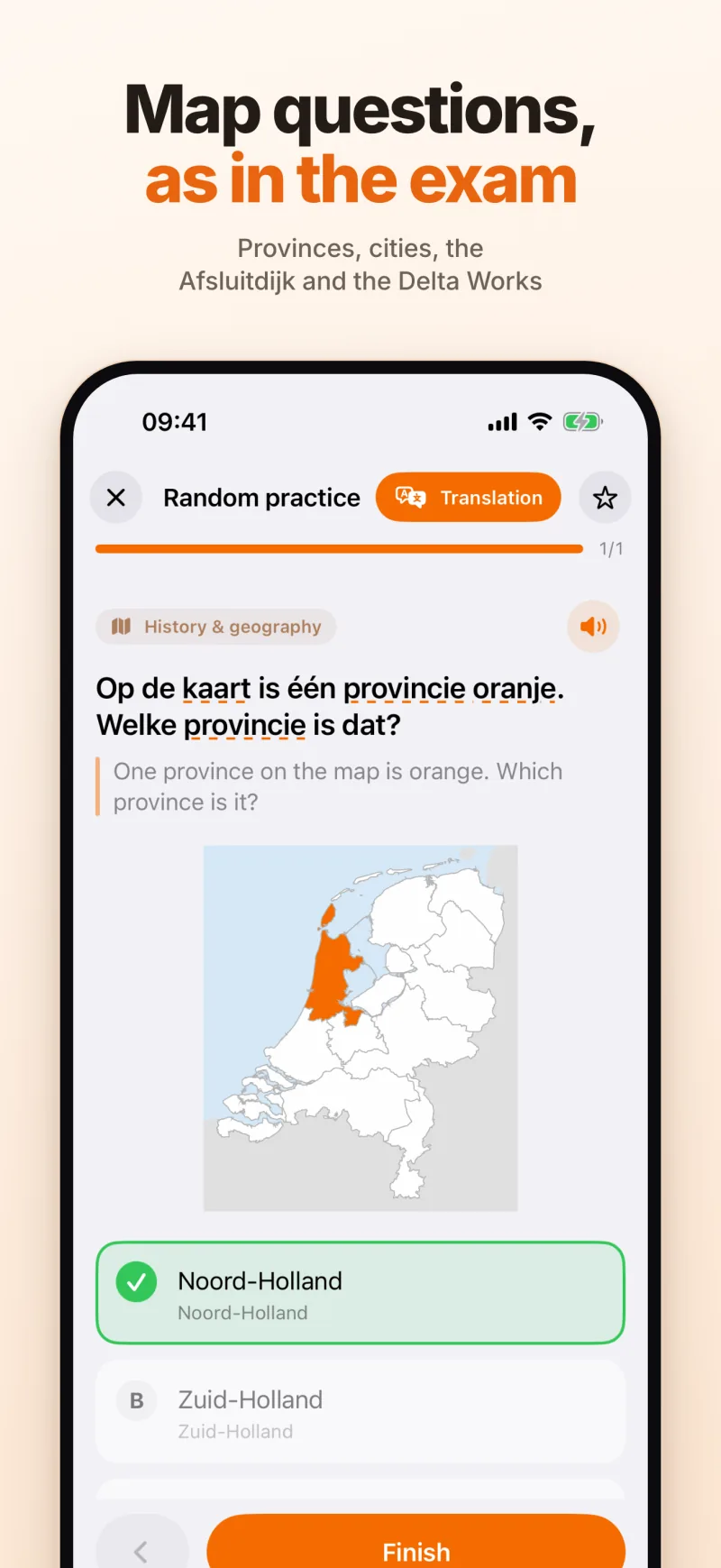
Turn on KNM words first and Tulp teaches the words that appear in its KNM questions before other words of the same level; each KNM theme also has its own word list. In a question, tap any word to look it up and save it, and words you haven't learned yet are underlined.
A few minutes a day
Short daily sessions beat long weekly ones. Tulp's daily reminder says how many words are waiting and stays quiet on days you've finished; a streak and stats keep count. Everything works on the device, with no account.
Frequently asked questions
How many new words should I learn a day?
Fewer than you might think, because every new word brings reviews in the days after. Ten new words a day comes to more than 3,000 in a year. In Tulp you set the number, and reviews are scheduled on top.
Is there an official A2 or B1 word list?
No. The exams test whether you can use Dutch at that level. Course word lists, Tulp's included, are selections of the words people at that level need most.
Do I need to learn de and het?
Yes, for writing and speaking: the article decides the adjective ending (een grote tafel, een groot huis) and words like deze/dit. See de or het: eight rules of thumb.
Can I learn Dutch from English, Chinese or Japanese?
In Tulp, yes: meanings, translations and explanations come in English, Simplified Chinese or Japanese, and the Dutch comes with its pronunciation.